WASHINGTON, Feb. 15 — As the House prepared to pass a symbolic resolution denouncing President Bush’s war policy, Senate Democratic leaders on Thursday abruptly scheduled a weekend debate on Iraq in an effort to break a stalemate and avoid impressions that partisan bickering was weighing down deliberations over the war.
A steady line of Republicans and Democrats made their way to the House floor for a third straight day of debating Mr. Bush’s troop buildup plan before the matter comes to a vote Friday. The Senate, stung by its own failure so far to act, spent much of Thursday locked in a debate about debating until Senator Harry Reid, the majority leader, called the rare Saturday session.
“We demand an up-or-down vote on the resolution the House is debating as we speak,” said Mr. Reid, a Nevada Democrat. “We’re determined to give our troops and the American people the debate they deserve.”
But when they convene Saturday afternoon, senators will not debate the Iraq resolution itself. Instead, they will be taking up a procedural vote required under Senate rules to move forward to the actual debate.
Click for more
Friday, February 16, 2007


Libby's 'conspiracy theory' never took root in court

The "conspiracy theory" hinted at by former White House aide I. Lewis Libby's lawyers at the start of his trial "never really took root in court," notes an article in Friday's L.A. Times.
"In his opening statement three weeks ago in the federal perjury trial of I. Lewis 'Scooter' Libby, defense lawyer Theodore V. Wells Jr. dropped a bombshell," Richard B. Schmitt writes. "In dramatic tones, Wells declared that Libby had been the victim of a White House conspiracy to make Libby the fall guy for the CIA leak scandal."
Schmitt reports that "when the jury begins deliberating the fate of the former vice presidential aide next week, it will have seen virtually no evidence to back up the provocative claim."
"The difference between what Wells promised and delivered, and how it will play with the 12-member panel, is just one of the wild cards as the trial winds up," Schmitt continues.
"Endelivered promises" by defense attorneys may sometimes "backfire," because, as one former US Attorney tells the L.A. Times, it can potentially provide "the government an opportunity during closing arguments to cast doubt on the entire defense case."
Click
"In his opening statement three weeks ago in the federal perjury trial of I. Lewis 'Scooter' Libby, defense lawyer Theodore V. Wells Jr. dropped a bombshell," Richard B. Schmitt writes. "In dramatic tones, Wells declared that Libby had been the victim of a White House conspiracy to make Libby the fall guy for the CIA leak scandal."
Schmitt reports that "when the jury begins deliberating the fate of the former vice presidential aide next week, it will have seen virtually no evidence to back up the provocative claim."
"The difference between what Wells promised and delivered, and how it will play with the 12-member panel, is just one of the wild cards as the trial winds up," Schmitt continues.
"Endelivered promises" by defense attorneys may sometimes "backfire," because, as one former US Attorney tells the L.A. Times, it can potentially provide "the government an opportunity during closing arguments to cast doubt on the entire defense case."
Click
Thursday, February 15, 2007
Auditors: Billions squandered in Iraq
WASHINGTON - About $10 billion has been squandered by the U.S. government on Iraq reconstruction aid because of contractor overcharges and unsupported expenses, and federal investigators warned Thursday that significantly more taxpayer money is at risk.
The three top auditors overseeing work in Iraq told a House committee their review of $57 billion in Iraq contracts found that Defense and State department officials condoned or allowed repeated work delays, bloated expenses and payments for shoddy work or work never done.
More than one in six dollars charged by U.S. contractors were questionable or unsupported, nearly triple the amount of waste the Government Accountability Office estimated last fall.
Click for more
The three top auditors overseeing work in Iraq told a House committee their review of $57 billion in Iraq contracts found that Defense and State department officials condoned or allowed repeated work delays, bloated expenses and payments for shoddy work or work never done.
More than one in six dollars charged by U.S. contractors were questionable or unsupported, nearly triple the amount of waste the Government Accountability Office estimated last fall.
Click for more
Keeping Up With The Scooter Libby Trial...
From Firedoglake Live Blogging:
Bonamici: To the extent we were able to digest them (jury instructions) WRT elements instruction, govt concerned about summarization of false statements as part of elements instruction. We understand that the precise charge statements will be appended to the back. It was our understanding that the summaries of the false statements would only be provided at preliminary and that the false statements would be read for the final instructions.
Jeffress stands.
Bonamici: Is the perjury quoted as well.
Walton: Perjury is. I wouldn't be inclined to read all that, I would say it's going to get lost. I'd give a short statement about that and the jury will have an opportunity to read it.
Bonamici: We're of the view that the charged false statements are the core of the case.
Walton: I was only talking about the perjury.
Bonamici: They're shorter. I do see the distinction. We took from the first instruction that you were struggling with just reading them allowed.
Walton: As far as the false statements are, I thought I had indicated I would summarize what the false statements were.
Jeffress: [I think he says he was under the same understanding as Bonamici, too]
Bonamici: In the seventh circuit, the indictment goes back so it is never the practice to presesnt the false statement in the instructions.
Walton: I'm okay to have those portions of the indictment appended. I have a problem with the entire indictment going back bc there's a lot of stuff in there that should not be submitted to the jury.
Bonamici: That would be acceptable to the govt and would probably solve the problem.
Walton: I'm looking at the false statement instruction. I thought that was everything.
Bonamici: I don't, I don't. Have you figured out what page it's one.
Wells is up. Shows it to her. [Guess we have nice Ted today]
Click for more
Bonamici: To the extent we were able to digest them (jury instructions) WRT elements instruction, govt concerned about summarization of false statements as part of elements instruction. We understand that the precise charge statements will be appended to the back. It was our understanding that the summaries of the false statements would only be provided at preliminary and that the false statements would be read for the final instructions.
Jeffress stands.
Bonamici: Is the perjury quoted as well.
Walton: Perjury is. I wouldn't be inclined to read all that, I would say it's going to get lost. I'd give a short statement about that and the jury will have an opportunity to read it.
Bonamici: We're of the view that the charged false statements are the core of the case.
Walton: I was only talking about the perjury.
Bonamici: They're shorter. I do see the distinction. We took from the first instruction that you were struggling with just reading them allowed.
Walton: As far as the false statements are, I thought I had indicated I would summarize what the false statements were.
Jeffress: [I think he says he was under the same understanding as Bonamici, too]
Bonamici: In the seventh circuit, the indictment goes back so it is never the practice to presesnt the false statement in the instructions.
Walton: I'm okay to have those portions of the indictment appended. I have a problem with the entire indictment going back bc there's a lot of stuff in there that should not be submitted to the jury.
Bonamici: That would be acceptable to the govt and would probably solve the problem.
Walton: I'm looking at the false statement instruction. I thought that was everything.
Bonamici: I don't, I don't. Have you figured out what page it's one.
Wells is up. Shows it to her. [Guess we have nice Ted today]
Click for more
Pelosi: Bush lacks power to invade Iran
WASHINGTON - House Speaker Nancy Pelosi (news, bio, voting record) said Thursday that President Bush lacks the authority to invade Iran without specific approval from Congress, a fresh challenge to the commander in chief on the eve of a symbolic vote critical of his troop buildup in Iraq.
Pelosi, D-Calif., noted that Bush consistently said he supports a diplomatic resolution to differences with Iran "and I take him at his word."
At the same time, she said, "I do believe that Congress should assert itself, though, and make it very clear that there is no previous authority for the president, any president, to go into Iran."
Pelosi spoke in an interview in the Capitol as the House moved through a third marathon day of debate on a nonbinding measure that disapproves of the military buildup in Iraq while expressing support for the troops.
Passage of the measure was expected Friday, and across the Capitol, Senate Majority Leader Harry Reid (news, bio, voting record) unexpectedly announced plans to hold a test vote Saturday.
Partisan bickering has prevented a Senate vote on the troop increase, with Republicans insisting on equal treatment for an alternative rules out the "elimination or reduction of funds for troops in the field."
Pelosi and other Democrats have said approval on the nonbinding measure would mark the first step in an effort by the new Democratic-controlled Congress to force Bush to change course in a war that has killed more than 3,100 U.S. troops.
Click
Pelosi, D-Calif., noted that Bush consistently said he supports a diplomatic resolution to differences with Iran "and I take him at his word."
At the same time, she said, "I do believe that Congress should assert itself, though, and make it very clear that there is no previous authority for the president, any president, to go into Iran."
Pelosi spoke in an interview in the Capitol as the House moved through a third marathon day of debate on a nonbinding measure that disapproves of the military buildup in Iraq while expressing support for the troops.
Passage of the measure was expected Friday, and across the Capitol, Senate Majority Leader Harry Reid (news, bio, voting record) unexpectedly announced plans to hold a test vote Saturday.
Partisan bickering has prevented a Senate vote on the troop increase, with Republicans insisting on equal treatment for an alternative rules out the "elimination or reduction of funds for troops in the field."
Pelosi and other Democrats have said approval on the nonbinding measure would mark the first step in an effort by the new Democratic-controlled Congress to force Bush to change course in a war that has killed more than 3,100 U.S. troops.
Click
INTELLIGENCE LEAKS --Cheney's Call
Early on the morning of June 20, 2002, then-Senate Intelligence Committee Chairman Bob Graham, D-Fla., received a telephone call at home from a highly agitated Dick Cheney. Graham, who was in the middle of shaving, held a razor in one hand as he took the phone in the other.
The vice president got right to the point: A story in his morning newspaper reported that telephone calls intercepted by the National Security Agency on September 10, 2001, apparently warned that Al Qaeda was about to launch a major attack against the United States, possibly the next day. But the intercepts were not translated until September 12, 2001, the story said, the day after the terrorist attacks on the World Trade Center and the Pentagon.
Because someone had leaked the highly classified information from the NSA intercepts, Cheney warned Graham, the Bush administration was considering ending all cooperation with the joint inquiry by the Senate and House Intelligence committees on the government's failure to predict and prevent the September 11 attacks. Classified records would no longer be turned over to the Hill, the vice president threatened, and administration witnesses would not be available for interviews or testimony.
Click for more
The vice president got right to the point: A story in his morning newspaper reported that telephone calls intercepted by the National Security Agency on September 10, 2001, apparently warned that Al Qaeda was about to launch a major attack against the United States, possibly the next day. But the intercepts were not translated until September 12, 2001, the story said, the day after the terrorist attacks on the World Trade Center and the Pentagon.
Because someone had leaked the highly classified information from the NSA intercepts, Cheney warned Graham, the Bush administration was considering ending all cooperation with the joint inquiry by the Senate and House Intelligence committees on the government's failure to predict and prevent the September 11 attacks. Classified records would no longer be turned over to the Hill, the vice president threatened, and administration witnesses would not be available for interviews or testimony.
Click for more
Democratic Congressman: Rest assured that history, fact will not be kind to decision-makers of this war

Congressman Raul Grijalva (D-AZ) will say that "history and fact will not be kind to the decision-makers" during his House floor statement tonight concerning the Iraq War Resolution that will be voted on Friday, RAW STORY has learned.
"This head in the sand attitude, while politically expedient, denies reality and truth," Grijalva will say. "Rest assured that history and fact will not be kind to the decision-makers and deciders of this war."
Click
Justice Official Bought Vacation Home With Oil Lobbyist
A senior Justice Department official who recently resigned her post bought a nearly $1 million vacation home with a lobbyist for ConocoPhillips months before approving consent decrees that would give the oil company more time to pay millions of dollars in fines and meet pollution-cleanup rules at some of its refineries.
Sue Ellen Wooldridge, former assistant attorney general in charge of environment and natural resources, bought a $980,000 home on Kiawah Island, S.C., last March with ConocoPhillips lobbyist Don R. Duncan. A third owner of the house is J. Steven Griles, a former deputy interior secretary, who has been informed he is a target in the federal investigation of Jack Abramoff's lobbying activities.
A spokeswoman for the Justice Department said yesterday that Wooldridge sought and received approval from a career ethics official in her office before buying the vacation property. Wooldridge's lawyer and officials at ConocoPhillips said that Duncan had no role in negotiating the consent decrees and never lobbied Wooldridge.
Click for more
Sue Ellen Wooldridge, former assistant attorney general in charge of environment and natural resources, bought a $980,000 home on Kiawah Island, S.C., last March with ConocoPhillips lobbyist Don R. Duncan. A third owner of the house is J. Steven Griles, a former deputy interior secretary, who has been informed he is a target in the federal investigation of Jack Abramoff's lobbying activities.
A spokeswoman for the Justice Department said yesterday that Wooldridge sought and received approval from a career ethics official in her office before buying the vacation property. Wooldridge's lawyer and officials at ConocoPhillips said that Duncan had no role in negotiating the consent decrees and never lobbied Wooldridge.
Click for more
11 more Republicans get behind Iraq rebuke
The lawmakers take to the House floor to show support, reflecting the rising anxiety within the GOP over the war.
WASHINGTON — In a striking display of dissension, a group of Republican lawmakers broke ranks with the White House on Wednesday and embraced a resolution opposing more U.S. troops in Iraq — airing their criticism even as President Bush publicly defended his plan.
Bush questioned the message that expected House approval of the nonbinding resolution would send, saying at a news conference: "People are watching what happens here in America. The enemy listens to what's happening. The Iraqi people listen to the words…. They're wondering about our commitment to this cause."
Undaunted, 11 GOP lawmakers, including normally staunch Bush allies who represent districts he carried in his presidential campaigns, took to the House floor to express their support for a Democratic-sponsored resolution renouncing Bush's decision to add 21,500 troops to the roughly 135,000 already in Iraq.
The Republicans complained that the U.S. military finds itself in the middle of a civil war, that the Iraqis haven't done enough to make their country safe and that a "surge" in diplomacy — not troops — is needed.
Click for more
WASHINGTON — In a striking display of dissension, a group of Republican lawmakers broke ranks with the White House on Wednesday and embraced a resolution opposing more U.S. troops in Iraq — airing their criticism even as President Bush publicly defended his plan.
Bush questioned the message that expected House approval of the nonbinding resolution would send, saying at a news conference: "People are watching what happens here in America. The enemy listens to what's happening. The Iraqi people listen to the words…. They're wondering about our commitment to this cause."
Undaunted, 11 GOP lawmakers, including normally staunch Bush allies who represent districts he carried in his presidential campaigns, took to the House floor to express their support for a Democratic-sponsored resolution renouncing Bush's decision to add 21,500 troops to the roughly 135,000 already in Iraq.
The Republicans complained that the U.S. military finds itself in the middle of a civil war, that the Iraqis haven't done enough to make their country safe and that a "surge" in diplomacy — not troops — is needed.
Click for more
Wednesday, February 14, 2007
Testimony Ends in CIA Leak Trial
WASHINGTON -- Attorneys for former White House aide I. Lewis "Scooter" Libby rested their case in the CIA leak trial Wednesday after a day of legal wrangling over classified information and whether additional witnesses could be presented.
Special Prosecutor Patrick Fitzgerald called no rebuttal witnesses, ending the testimony phase of the trial. Closing arguments are scheduled for Tuesday.
The final day of testimony in Libby's perjury and obstruction trial had been billed as a blockbuster. Attorneys said for months that Libby and his boss, Vice President Dick Cheney, would testify for the defense.
But Libby's attorneys reversed course Tuesday and said neither man would testify, leaving Wednesday to fight over whether NBC newsman Tim Russert could be called back to testify and how much evidence jurors would hear in Libby's absence.
The change in who would testify prompted U.S. District Judge Reggie B. Walton to reverse course, too. He told defense attorneys that if Libby didn't testify he would not allow some classified information to be presented to the jury as Libby's defense team had planned.
"My absolute understanding was that Mr. Libby was going to testify," Walton said, recalling why he had agreed months ago to allow some classified information into evidence. "My ruling was based on the fact that he was going to testify."
Click for more
Special Prosecutor Patrick Fitzgerald called no rebuttal witnesses, ending the testimony phase of the trial. Closing arguments are scheduled for Tuesday.
The final day of testimony in Libby's perjury and obstruction trial had been billed as a blockbuster. Attorneys said for months that Libby and his boss, Vice President Dick Cheney, would testify for the defense.
But Libby's attorneys reversed course Tuesday and said neither man would testify, leaving Wednesday to fight over whether NBC newsman Tim Russert could be called back to testify and how much evidence jurors would hear in Libby's absence.
The change in who would testify prompted U.S. District Judge Reggie B. Walton to reverse course, too. He told defense attorneys that if Libby didn't testify he would not allow some classified information to be presented to the jury as Libby's defense team had planned.
"My absolute understanding was that Mr. Libby was going to testify," Walton said, recalling why he had agreed months ago to allow some classified information into evidence. "My ruling was based on the fact that he was going to testify."
Click for more

Bush will address Iraq, North Korea
WASHINGTON (CNN) -- President Bush will hold a brief news conference at 11 a.m. Wednesday at the White House in which he will talk about Iraq and North Korea and take questions, a senior administration official told CNN.
The president will also discuss the resolution being debated in the House this week that expresses disapproval of Bush's plan to send an additional 21,000 troops to Iraq, the official said.
Bush will have talked to his new commander on the ground in Iraq, Gen. David Petraeus, before Wednesday's news conference, the official said.
Click
The president will also discuss the resolution being debated in the House this week that expresses disapproval of Bush's plan to send an additional 21,000 troops to Iraq, the official said.
Bush will have talked to his new commander on the ground in Iraq, Gen. David Petraeus, before Wednesday's news conference, the official said.
Click
Tuesday, February 13, 2007
Cheney, Libby won't testify at CIA leak trial
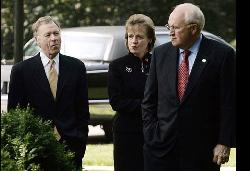
Vice President Dick Cheney will not testify as expected in the trial of his former chief of staff I. Lewis 'Scooter' Libby, according to a report on MSNBC. CNN reports that Libby himself will not be testifying, either.
A snow storm shut down government agencies in Washington today, prompting the court to send the jury home early for the day. But before wrapping up all proceedings, Libby's lead counsel Theodore Wells announced that he had released the Vice President from being a witness.
Cheney’s testimony had been widely anticipated by followers of the trial.
Liveblogging the trial at Firedoglake, Marcy Wheeler, author of the recently published Anatomy of Deceit: How the Bush Administration Used the Media to Sell the Iraq War and Out a Spy (aka emptywheel) provides a "blogger's approximation" transcript.
"Prior to lunch I indicated to the court that I would be making recommendations to Libby with regards to the progress of his case," Wells told the courtroom, according to emptywheel. "Over the lunch hour Mr. Jeffress and I advised Cheney's lawyer."
"If we had called him he would have been available on Thursday," Wells reportedly continued. "We have released the vice president as a witness."
The two lawyers advised Libby to rest his case without testifying.
Click
House members joust over Iraq war policy
WASHINGTON - House members fiercely debated Iraq war policy Tuesday in an emotional and historic floor faceoff over a conflict that Speaker Nancy Pelosi (news, bio, voting record) lambasted as a U.S. commitment with "no end in sight."
The confluence of arguments came as the war nears the four-year point with over 3,100 American deaths, billions spent and lawmakers grappling what position to take on President Bush's decision to send an additional 21,500 troops into battle.
"The American people have lost faith in President Bush's course of action in Iraq and they are demanding a new direction," said Pelosi, a California Democrat who became the first female House speaker after her party took control of both the House and Senate in the fall elections.
A resolution putting the House on record as against Bush's expansion of troop strength was expected to be approved by week's end. It was nonbinding, but nevertheless unmistakable in its message. "No more blank checks for President Bush on Iraq," Pelosi declared.
Countered White House press secretary Tony Snow: "Members of the House and members of the Senate have the freedom to go ahead and write their resolutions, and do what they want with them. The one thing we do expect is, we do expect those who say they're going to support the troops, to support them."
Republicans, now the minority party on the Hill for the time in 12 years, issued impassioned warnings of the consequences of undermining the president's policies in Iraq. "We will embolden terrorists in every corner in the world. We will give Iran free access to the Middle East," said Republican leader John Boehner (news, bio, voting record), R-Ohio. "And who doesn't believe the terrorists will just follow our troops home?"
Click for more
The confluence of arguments came as the war nears the four-year point with over 3,100 American deaths, billions spent and lawmakers grappling what position to take on President Bush's decision to send an additional 21,500 troops into battle.
"The American people have lost faith in President Bush's course of action in Iraq and they are demanding a new direction," said Pelosi, a California Democrat who became the first female House speaker after her party took control of both the House and Senate in the fall elections.
A resolution putting the House on record as against Bush's expansion of troop strength was expected to be approved by week's end. It was nonbinding, but nevertheless unmistakable in its message. "No more blank checks for President Bush on Iraq," Pelosi declared.
Countered White House press secretary Tony Snow: "Members of the House and members of the Senate have the freedom to go ahead and write their resolutions, and do what they want with them. The one thing we do expect is, we do expect those who say they're going to support the troops, to support them."
Republicans, now the minority party on the Hill for the time in 12 years, issued impassioned warnings of the consequences of undermining the president's policies in Iraq. "We will embolden terrorists in every corner in the world. We will give Iran free access to the Middle East," said Republican leader John Boehner (news, bio, voting record), R-Ohio. "And who doesn't believe the terrorists will just follow our troops home?"
Click for more
Foggo Indictment Expected; Dark Day for the CIA

Federal prosecutors in San Diego are expected today to announce indictments in a case that involves the former No. 3 official at the CIA, Kyle "Dusty" Foggo, officials tell ABC News.
Foggo, who served as the CIA's executive director, was accused last year by fellow CIA employees of steering contracts for the CIA station in Iraq to longtime friend Brent Wilkes, a defense contractor whose activities also led to the indictment of former Republican Congressman Duke Cunningham.
Officials said today's expected indictments will also include Wilkes.
At his home in suburban Washington, D.C., this morning, Foggo declined to comment to ABC News.
Wilkes' lawyer, Mark Geragos, also declined to comment.
If Foggo is indicted, it will represent a dark day for the CIA and is expected to lead to a full congressional investigation of how secret CIA contracts are awarded.
Foggo was promoted from a field logistics position to the powerful No. 3 position by Porter Goss when Goss took over the CIA. Goss resigned shortly after ABC News reported that Foggo was under criminal investigation, although officials say none of the allegations involve Goss.
At the time, officials close to Goss dismissed the investigation of Foggo "as existing only in the blogosphere" and tried to discourage ABC News from reporting the story.
Click
Foggo, who served as the CIA's executive director, was accused last year by fellow CIA employees of steering contracts for the CIA station in Iraq to longtime friend Brent Wilkes, a defense contractor whose activities also led to the indictment of former Republican Congressman Duke Cunningham.
Officials said today's expected indictments will also include Wilkes.
At his home in suburban Washington, D.C., this morning, Foggo declined to comment to ABC News.
Wilkes' lawyer, Mark Geragos, also declined to comment.
If Foggo is indicted, it will represent a dark day for the CIA and is expected to lead to a full congressional investigation of how secret CIA contracts are awarded.
Foggo was promoted from a field logistics position to the powerful No. 3 position by Porter Goss when Goss took over the CIA. Goss resigned shortly after ABC News reported that Foggo was under criminal investigation, although officials say none of the allegations involve Goss.
At the time, officials close to Goss dismissed the investigation of Foggo "as existing only in the blogosphere" and tried to discourage ABC News from reporting the story.
Click
Monday, February 12, 2007
GOP Expects Defections as House Debates Iraq Resolution
Three days of intense debate over the Iraq war begins in the House today, with Democrats planning to propose a narrowly worded rebuke of President Bush's troop buildup and Republicans girding for broad defections on their side.
Both parties will jockey for prime time before the C-SPAN cameras, with leaders claiming the best time slots and rank-and-file members trying to make the most of the five minutes each will be allotted. If all 435 House members use their five minutes, debate will last 36 hours. It is likely to begin by late morning and run until midnight tomorrow, Wednesday and Thursday. A vote is expected Friday.
After watching their counterparts in the Senate stall and sputter last week, unable to agree on ground rules for a debate on Iraq, House leaders are forging ahead, determined to send a statement to the White House to condemn a troop buildup.
Democrats will file a nonbinding resolution against the Bush plan while Republicans will try to broaden the dispute and seed doubt in the Democratic approach. Although Senate Republicans were able to block debate on a resolution condemning Bush's war policies last week, it will be much easier for Democrats in the House to bring a measure to the floor.
The GOP, whose members have conceded they are likely to lose, is treating the debate like a mini-political campaign, deploying a rapid-response team to counter Democrats' statements, aggressively trying to get its leaders on television and radio, and creating a "resource center" off the House floor where members can fill their arms with maps, research material, videos or other visual aids to use during their floor time.
"We may lose the vote, but we'll win the debate," said Kevin Smith, a spokesman for House Minority Leader John A. Boehner (R-Ohio).
Click for more on this story
Both parties will jockey for prime time before the C-SPAN cameras, with leaders claiming the best time slots and rank-and-file members trying to make the most of the five minutes each will be allotted. If all 435 House members use their five minutes, debate will last 36 hours. It is likely to begin by late morning and run until midnight tomorrow, Wednesday and Thursday. A vote is expected Friday.
After watching their counterparts in the Senate stall and sputter last week, unable to agree on ground rules for a debate on Iraq, House leaders are forging ahead, determined to send a statement to the White House to condemn a troop buildup.
Democrats will file a nonbinding resolution against the Bush plan while Republicans will try to broaden the dispute and seed doubt in the Democratic approach. Although Senate Republicans were able to block debate on a resolution condemning Bush's war policies last week, it will be much easier for Democrats in the House to bring a measure to the floor.
The GOP, whose members have conceded they are likely to lose, is treating the debate like a mini-political campaign, deploying a rapid-response team to counter Democrats' statements, aggressively trying to get its leaders on television and radio, and creating a "resource center" off the House floor where members can fill their arms with maps, research material, videos or other visual aids to use during their floor time.
"We may lose the vote, but we'll win the debate," said Kevin Smith, a spokesman for House Minority Leader John A. Boehner (R-Ohio).
Click for more on this story
Media Figures May Be Reluctant Defense Witnesses in Libby Case
Defense Exhibit 1972, a tape-recorded interview from the "Imus in the Morning" radio show, is another of those revealing moments in the perjury trial of I. Lewis "Scooter" Libby.
"So . . . what happened?" radio host Don Imus asks NBC News correspondent Andrea Mitchell about her confusing reporting on an undercover CIA officer. "Were you drunk?"
"I obviously screwed up," Mitchell responds in the exchange, which Libby's defense hopes to play for the jury in coming days. "I guess I was drunk," she jokes.
Just when you thought it was impossible for more harm to come to the national news media's reputation, the defense in the trial of Vice President Cheney's former chief of staff is about to present its case.
Starting today, when Libby's attorneys try to show that he did not intentionally lie about his role in leaking the identity of CIA officer Valerie Plame, they will rely heavily on a string of journalists as witnesses. In several ways, those witnesses will be asked to raise doubts about the testimony and accuracy of other reporters, and some may end up tarnishing themselves or their sources.
Libby, 56, is charged with lying to investigators about his conversations with reporters about Plame in the summer of 2003, during what prosecutors allege was a White House campaign to discredit her husband, outspoken war critic Joseph C. Wilson IV. Days after Wilson accused the administration of twisting intelligence he gathered on a CIA-sponsored mission as it defended the invasion of Iraq, Plame's classified CIA role was revealed in a syndicated column by Robert D. Novak. Libby, who has pleaded not guilty, is not charged with the leak itself.
Click for more
"So . . . what happened?" radio host Don Imus asks NBC News correspondent Andrea Mitchell about her confusing reporting on an undercover CIA officer. "Were you drunk?"
"I obviously screwed up," Mitchell responds in the exchange, which Libby's defense hopes to play for the jury in coming days. "I guess I was drunk," she jokes.
Just when you thought it was impossible for more harm to come to the national news media's reputation, the defense in the trial of Vice President Cheney's former chief of staff is about to present its case.
Starting today, when Libby's attorneys try to show that he did not intentionally lie about his role in leaking the identity of CIA officer Valerie Plame, they will rely heavily on a string of journalists as witnesses. In several ways, those witnesses will be asked to raise doubts about the testimony and accuracy of other reporters, and some may end up tarnishing themselves or their sources.
Libby, 56, is charged with lying to investigators about his conversations with reporters about Plame in the summer of 2003, during what prosecutors allege was a White House campaign to discredit her husband, outspoken war critic Joseph C. Wilson IV. Days after Wilson accused the administration of twisting intelligence he gathered on a CIA-sponsored mission as it defended the invasion of Iraq, Plame's classified CIA role was revealed in a syndicated column by Robert D. Novak. Libby, who has pleaded not guilty, is not charged with the leak itself.
Click for more
Sunday, February 11, 2007
NYT: Cheney expected to make 'historic appearance' on witness stand at CIA leak trial
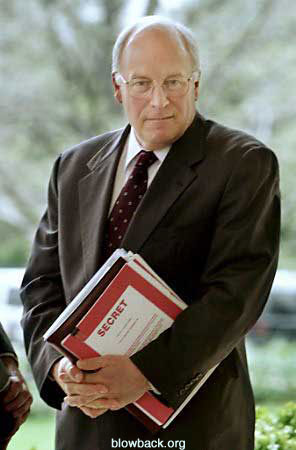
Vice President Dick Cheney is expected to make a "historic appearance" on the witness stand at the trial for his former aide, I. Lewis Libby, who is accused of obstructing justice and lying to officials investigating the Bush Administration's alleged "outing" of a CIA officer, Monday's New York Times reports.
"One witness has dominated the trial of I. Lewis Libby Jr. without even showing up in the courtroom," Scott Shane and Jim Rutenberg write for the Times.
The article continues, "Day after day, the jury has heard accounts of the actions of Vice President Dick Cheney, watched as his handwritten notes were displayed on a giant screen, heard how he directed leaks to the press and ordered the White House to publicly defend Libby, his top aide and close confidante."
"Now, as the defense phase of the perjury trial begins, Cheney is expected to make an historic appearance on the witness stand," the Times reports. "It is an act of loyalty that carries considerable risk for Cheney."
Law professor Peter Shane tells the Times that it could make "great theater," because whatever the vice president testifies to would then become "fair game" for the prosecution to use against him on cross-examination.
"If Cheney makes a statement that conflicts with the public record — and nearly every witness so far has done so at least once — it could prove embarrassing for him and for the administration," Shane and Rutenberg write.
A former federal prosecutor, described by the paper as one who "knows" Special Counsel Patrick J. Fitzgerald personally, says, "If Cheney said anything that's contradicted in the record, though I think that's unlikely, Pat will slam him." The Times' source adds that Fitzgerald will "do it respectfully, but I have no doubt he'll do it."
In addition, a sidebar story, written by David Johnson, is also slated to run in Monday's paper which will take "a look back at instances when presidents or vice presidents were called to testify."
Click for more
McCain criticizes Europe on Afghanistan
MUNICH, Germany (Reuters) - Senator John McCain, a Republican contender for the White House in 2008, chastised Europe on Saturday for failing to supply the troops and money to win in Afghanistan and said NATO's future was at stake.
In tough comments that singled out specific countries, McCain told NATO allies to move beyond the "false debate" over security and development priorities in Afghanistan -- a dispute that dominated a defense ministers' meeting earlier this week.
Instead, Europe should follow Washington's lead and put more forces and resources into the war effort.
"Military recommitment must begin with NATO countries providing an adequate number of troops for the fight," McCain told the Munich Security Conference of senior world politicians, including Russian President Vladimir Putin and Defense Secretary Robert Gates.
"... Yet the international community still falls far short in meeting its prior pledges and in committing the resources Afghanistan needs to avoid failure," he said in prepared remarks.
The senator's comments were more pointed in their criticism of Europe than other public statements from President George W. Bush's administration.
But they reflected growing frustration among some U.S. officials and others in Washington over what is seen as Europe's unwillingness to pay its fair share for involvement in Afghanistan.
Germany and Italy were singled out in McCain's speech. He said Germany must significantly increase police trainers in Afghanistan and Italy, responsible for judicial reform in the country, should raise more funds internationally for reform efforts he said were needed to curb government corruption.
Click
In tough comments that singled out specific countries, McCain told NATO allies to move beyond the "false debate" over security and development priorities in Afghanistan -- a dispute that dominated a defense ministers' meeting earlier this week.
Instead, Europe should follow Washington's lead and put more forces and resources into the war effort.
"Military recommitment must begin with NATO countries providing an adequate number of troops for the fight," McCain told the Munich Security Conference of senior world politicians, including Russian President Vladimir Putin and Defense Secretary Robert Gates.
"... Yet the international community still falls far short in meeting its prior pledges and in committing the resources Afghanistan needs to avoid failure," he said in prepared remarks.
The senator's comments were more pointed in their criticism of Europe than other public statements from President George W. Bush's administration.
But they reflected growing frustration among some U.S. officials and others in Washington over what is seen as Europe's unwillingness to pay its fair share for involvement in Afghanistan.
Germany and Italy were singled out in McCain's speech. He said Germany must significantly increase police trainers in Afghanistan and Italy, responsible for judicial reform in the country, should raise more funds internationally for reform efforts he said were needed to curb government corruption.
Click
Gates dismisses Putin remarks as blunt spy talk
MUNICH, Germany (Reuters) - Defense Secretary Robert Gates on Sunday dismissed an attack on U.S. foreign policy by Russian President Vladimir Putin as the blunt talk of an old spy and said it was vital to keep working with Moscow.
In a speech which one U.S. senator said smacked of Cold War rhetoric, Putin told a security conference in Munich on Saturday the United States was making the world a more dangerous place by pursuing policies aimed at making it the "one single master."
A White House spokesman said it was "surprised and disappointed" by the comments and some Europeans said it was a wake-up call from a tougher Russia, newly empowered by a sharp rise in the prices of its oil, gas and metals exports.
But despite their concerns, the White House and Gates underlined the need for cooperation with Moscow.
"Many of you have backgrounds in diplomacy or politics," Gates, a former CIA director, told the same Munich conference.
"I have, like your second speaker yesterday (Putin), a starkly different background -- a career in the spy business. And, I guess, old spies have a habit of blunt speaking.
Gates raised concerns about Russian arms transfers and its "temptation to use energy resources for political coercion" which he said could threaten international stability.
But he said: "We all face many common problems and challenges that must be addressed in partnership with other countries, including Russia."
"One Cold War was quite enough," he added.
Russian Defense Minister Sergei Ivanov, addressing the conference, also underlined the potential for cooperation between the old foes to fight the new threat of terrorism.
"We need to use all the efforts of the world community in countering terrorists and to concentrate our efforts at the most vulnerable spots," he said. He proposed cutting off militants' financial channels and preventing them recruiting.
Click for more
In a speech which one U.S. senator said smacked of Cold War rhetoric, Putin told a security conference in Munich on Saturday the United States was making the world a more dangerous place by pursuing policies aimed at making it the "one single master."
A White House spokesman said it was "surprised and disappointed" by the comments and some Europeans said it was a wake-up call from a tougher Russia, newly empowered by a sharp rise in the prices of its oil, gas and metals exports.
But despite their concerns, the White House and Gates underlined the need for cooperation with Moscow.
"Many of you have backgrounds in diplomacy or politics," Gates, a former CIA director, told the same Munich conference.
"I have, like your second speaker yesterday (Putin), a starkly different background -- a career in the spy business. And, I guess, old spies have a habit of blunt speaking.
Gates raised concerns about Russian arms transfers and its "temptation to use energy resources for political coercion" which he said could threaten international stability.
But he said: "We all face many common problems and challenges that must be addressed in partnership with other countries, including Russia."
"One Cold War was quite enough," he added.
Russian Defense Minister Sergei Ivanov, addressing the conference, also underlined the potential for cooperation between the old foes to fight the new threat of terrorism.
"We need to use all the efforts of the world community in countering terrorists and to concentrate our efforts at the most vulnerable spots," he said. He proposed cutting off militants' financial channels and preventing them recruiting.
Click for more
Saturday, February 10, 2007
CIA doubts didn't deter Feith's team
Intelligence agencies disagreed with many of its prewar findings.
WASHINGTON — As the Bush administration began assembling its case for war, analysts across the U.S. intelligence community were disturbed by the report of a secretive Pentagon team that concluded Iraq had significant ties to Al Qaeda.
Analysts from the CIA and other agencies "disagreed with more than 50%" of 26 findings the Pentagon team laid out in a controversial paper, according to testimony Friday from Thomas F. Gimble, acting inspector general of the Pentagon.
The dueling groups sat down at CIA headquarters in late August 2002 to try to work out their differences. But while the CIA agreed to minor modifications in some of its own reports, Gimble said, the Pentagon unit was utterly unbowed.
"They didn't make the changes that were talked about in that August 20th meeting," Gimble said, and instead went on to present their deeply flawed findings to senior officials at the White House.
The work of that special Pentagon unit — which was run by former Undersecretary of Defense Douglas J. Feith — is one of the lingering symbols of the intelligence failures leading up to the war in Iraq.
The Bush administration's primary justification for invading Iraq was always its assertion that Saddam Hussein possessed weapons of mass destruction. But Iraq's supposed ties to Al Qaeda — and therefore its connection to the Sept. 11 terrorist attacks — were an important secondary argument, and one that resonated with many Americans in the lead-up to the war with Iraq.
The CIA and many other intelligence agencies were wrong in their assessments of Iraq's weapons programs. But the agency was always deeply skeptical about the ties between Iraq and Al Qaeda.
WASHINGTON — As the Bush administration began assembling its case for war, analysts across the U.S. intelligence community were disturbed by the report of a secretive Pentagon team that concluded Iraq had significant ties to Al Qaeda.
Analysts from the CIA and other agencies "disagreed with more than 50%" of 26 findings the Pentagon team laid out in a controversial paper, according to testimony Friday from Thomas F. Gimble, acting inspector general of the Pentagon.
The dueling groups sat down at CIA headquarters in late August 2002 to try to work out their differences. But while the CIA agreed to minor modifications in some of its own reports, Gimble said, the Pentagon unit was utterly unbowed.
"They didn't make the changes that were talked about in that August 20th meeting," Gimble said, and instead went on to present their deeply flawed findings to senior officials at the White House.
The work of that special Pentagon unit — which was run by former Undersecretary of Defense Douglas J. Feith — is one of the lingering symbols of the intelligence failures leading up to the war in Iraq.
The Bush administration's primary justification for invading Iraq was always its assertion that Saddam Hussein possessed weapons of mass destruction. But Iraq's supposed ties to Al Qaeda — and therefore its connection to the Sept. 11 terrorist attacks — were an important secondary argument, and one that resonated with many Americans in the lead-up to the war with Iraq.
The CIA and many other intelligence agencies were wrong in their assessments of Iraq's weapons programs. But the agency was always deeply skeptical about the ties between Iraq and Al Qaeda.
Russia's Putin says US wants to dominate world

Russian President Vladimir Putin launched a full-frontal attack on the United States, saying it had broken from international law and made the world a more dangerous place.
Putin's denunciation of US policy, made at a high-level security conference in Munich, prompted dismay among senior officials and politicians from the United States and the North Atlantic Treaty Organisation (NATO).
The United States had disastrously "overstepped" its borders, said the Russian leader, who spearheaded international opposition to the 2003 US-led invasion of Iraq, which was also opposed by Germany and France.
"The United States has overstepped its borders in all spheres -- economic, political and humanitarian and has imposed itself on other states," Putin said at the annual Munich Conference on Security Policy.
What he called a "uni-polar" world dominated by the United States, "means in practice one thing: one centre of power, one centre of force, one centre of decision-making, a world of one master, one sovereign," Putin said.
Such a situation was "extremely dangerous. No one feels secure because no one can hide behind international law."
Click for more
Trial exposes White House crisis machine

WASHINGTON - David Addington, chief legal adviser to Vice President Dick Cheney, says he was taken aback when the White House started making public pronouncements about the CIA leak investigation.
In the fall of 2003, President Bush's press secretary was categorically denying that either Karl Rove or I. Lewis "Scooter" Libby was involved in exposing the identity of Valerie Plame, a CIA employee married to a critic of the war in Iraq.
"Why are you making these statements?" Addington asked White House communications director Dan Bartlett.
"Your boss is the one who wanted" them, Bartlett replied, referring to Cheney.
With that, "I shut up," Addington recalled recently for jurors in Libby's CIA leak trial, which begins its fourth week on Monday with Libby's lawyers calling their first witnesses.
So far, the testimony of Addington and other administration aides, along with documents and Libby's audiotaped grand jury testimony, have provided a rare glimpse of how the Bush White House scrambled to respond to a political crisis as it intersected a criminal investigation.
At the intersection was Cheney, along with Rove and Libby, who were working in the summer of 2003 to rebut claims by Plame's husband, former Ambassador Joseph Wilson, that Bush had misled the nation about prewar intelligence on Iraq.
The White House denials on behalf of Rove and Libby came just before Rove secretly began acknowledging to the FBI that he had confirmed Plame's identity for conservative columnist Bob Novak, who first published her name and relationship to Wilson.
About the same time, Libby came under suspicion because NBC News Washington bureau chief Tim Russert had talked to the FBI, contradicting Libby's version of a conversation between the two men that would become the heart of the perjury and obstruction charges against Libby.
Bush and Cheney made a common mistake in their public handling of the Plame affair, says presidential scholar and University of Texas government professor Bruce Buchanan, who has watched Bush's career since his days as Texas governor.
Click for more
Friday, February 09, 2007
Key House Democrat to hold hearings on recent firing of U.S. Attorneys
 A key House Democrat is announcing her plan for hearings on the recent dismissal of U.S. Attorneys, according to a press release.
"Congresswoman Linda Sánchez, Chairwoman of the House Judiciary Subcommittee on Commercial and Administrative Law (CAL), today announced her intention to begin hearings on the Bush Administration's recent firing of seven U.S. Attorneys," the release states.
Sánchez' jurisdiction in her role on the subcommittee "includes oversight of certain federal agencies," one of them being the Office of the U.S. Attorneys, according to the release.
"I'm calling this hearing because we need to make sure that the selection of federal prosecutors is not being made for political reasons," Chairwoman Sánchez is quoted. "No presidential administration - now or in the future - should be allowed to dismantle the important constitutional set of checks and balances to achieve a political agenda."
Click
Official's Key Report On Iraq Is Faulted
'Dubious' Intelligence Fueled Push for War
Intelligence provided by former undersecretary of defense Douglas J. Feith to buttress the White House case for invading Iraq included "reporting of dubious quality or reliability" that supported the political views of senior administration officials rather than the conclusions of the intelligence community, according to a report by the Pentagon's inspector general.
Feith's office "was predisposed to finding a significant relationship between Iraq and al Qaeda," according to portions of the report, released yesterday by Sen. Carl M. Levin (D-Mich.). The inspector general described Feith's activities as "an alternative intelligence assessment process."
An unclassified summary of the full document is scheduled for release today in a hearing of the Senate Armed Services Committee, which Levin chairs. In that summary, a copy of which was obtained from another source by The Washington Post, the inspector general concluded that Feith's assessment in 2002 that Iraq and al-Qaeda had a "mature symbiotic relationship" was not fully supported by available intelligence but was nonetheless used by policymakers.
At the time of Feith's reporting, the CIA had concluded only that there was an "evolving" association, "based on sources of varying reliability."
Click for more
Intelligence provided by former undersecretary of defense Douglas J. Feith to buttress the White House case for invading Iraq included "reporting of dubious quality or reliability" that supported the political views of senior administration officials rather than the conclusions of the intelligence community, according to a report by the Pentagon's inspector general.
Feith's office "was predisposed to finding a significant relationship between Iraq and al Qaeda," according to portions of the report, released yesterday by Sen. Carl M. Levin (D-Mich.). The inspector general described Feith's activities as "an alternative intelligence assessment process."
An unclassified summary of the full document is scheduled for release today in a hearing of the Senate Armed Services Committee, which Levin chairs. In that summary, a copy of which was obtained from another source by The Washington Post, the inspector general concluded that Feith's assessment in 2002 that Iraq and al-Qaeda had a "mature symbiotic relationship" was not fully supported by available intelligence but was nonetheless used by policymakers.
At the time of Feith's reporting, the CIA had concluded only that there was an "evolving" association, "based on sources of varying reliability."
Click for more
Gonzales' sacking of US Attorneys like a 'coup de'tat'

A columnist at Salon has described Attorney General Alberto Gonzales' sacking of United States Attorneys involved in controversial prosecutions as an act that amounts to a 'coup d'etat.'
Joe Conason highlights the removal from office of Carol Lam, Bud Cummings, and John McKay, U.S. Attorneys in San Diego, Little Rock, and Seattle respectively, whose prosecutions ran against the partisan interests of the Bush White House. These acts, Conason writes, suggest that "the White House and the Justice Department have been exposed in a secretive attempt to expand executive power for partisan purposes."
The ability of the White House to swap out U.S. Attorneys with partisan appointees resulted when the staff of Senator Arlen Specter inserted a measure in the renewal of the USA Patriot Act that "permitted the White House to place its own appointees in vacant U.S. attorney positions permanently and without Senate confirmation." According to Conason, Specter says he was not aware of the action by a member of his staff.
The Senate Judiciary Committee is working to restore the US Attorney appointment system to its earlier nonpartisan status. Conason hopes that they will go further in their response.
Click
Libby's lawyers may not call Cheney to testify
WASHINGTON (CNN) -- I. Lewis "Scooter" Libby's lawyers are debating whether to call Libby's former boss, Vice President Dick Cheney, to the stand, a source with knowledge of the lawyers' discussions told CNN on Thursday.
Libby's lawyers also are debating whether Libby should testify, the source said.
Libby, Cheney's former chief of staff, is on trial in Washington on charges that he lied to investigators and a grand jury investigating the leak of the information that Valerie Plame was a covert CIA operative. Knowingly identifying a covert agent is illegal.
Libby is not charged with leaking the information.
The source said it does not seem a decision has been made about whether either will testify. (Watch why putting Cheney on the stand could harm the defense )
Click for more
Thursday, February 08, 2007
House Democrats Set Framework for Iraq Vote
WASHINGTON, Feb. 8 — House Democratic leaders said today that the Iraq war resolution scheduled to be debated next week would be limited to President Bush’s plan to dispatch more troops to Baghdad, leaving any controversial decisions over war spending for a later discussion.
Speaker Nancy Pelosi, Democrat of California, and other party leaders met with members of the Democratic caucus for more than an hour today to discuss the framework of the first major debate over Iraq since Democrats took control of Congress last month. The three-day debate is set to begin next Tuesday.
The leaders reassured Democrats that the nonbinding, symbolic vote against the troop buildup plan would be the first — not the final — expression of opposition to the war. A letter signed by 71 House Democrats urged the party’s leaders to take a stronger stance, including outlining a six-month troop withdrawal plan.
“There’s no doubt that everybody in the caucus understands that this is a first step — an important step for Congress to express their view of support or opposition to the escalation and the increase of troop levels,” said Representative Steny H. Hoyer of Maryland, the majority leader.
The Iraq resolution will allow lawmakers to voice their support for the troops, Mr. Hoyer said, even as they state their opposition to the Bush administration’s Iraq policy.
Click
Speaker Nancy Pelosi, Democrat of California, and other party leaders met with members of the Democratic caucus for more than an hour today to discuss the framework of the first major debate over Iraq since Democrats took control of Congress last month. The three-day debate is set to begin next Tuesday.
The leaders reassured Democrats that the nonbinding, symbolic vote against the troop buildup plan would be the first — not the final — expression of opposition to the war. A letter signed by 71 House Democrats urged the party’s leaders to take a stronger stance, including outlining a six-month troop withdrawal plan.
“There’s no doubt that everybody in the caucus understands that this is a first step — an important step for Congress to express their view of support or opposition to the escalation and the increase of troop levels,” said Representative Steny H. Hoyer of Maryland, the majority leader.
The Iraq resolution will allow lawmakers to voice their support for the troops, Mr. Hoyer said, even as they state their opposition to the Bush administration’s Iraq policy.
Click
Chief counsel to committee that probed Nixon abuse of power wants similar Bush probe

Staffers to onetime committee voice mixed opinions
The chief counsel to the committee that investigated abuses of power by President Richard Nixon in the 1970s tells RAW STORY he’d like to see a similar inquiry into clandestine intelligence operations under President George W. Bush.
Frederick A.O. Schwarz, who presently works as Senior Counsel at the New York University School of Law’s Brennan Center for Social Justice, served as chief counsel to the Church Committee from 1975-1976. The committee drew its name from Senator Frank Church (D-ID) (in photo), who led the massive probe into abuses of power by US intelligence agencies.
Click for more
Tim Russert Contradicts Libby's Testimony

"Meet The Press" Anchor Tells Courtroom He Never Discussed CIA Operative With Former Cheney Aide
(CBS/AP) NBC newsman Tim Russert testified Wednesday he never discussed a CIA operative with vice presidential aide I. Lewis "Scooter" Libby, contradicting Libby's version to a grand jury in the CIA leak investigation.
The testimony came as prosecutors prepared to rest their perjury case against Vice President Dick Cheney's former chief of staff.
The courtroom testimony so far has provided a rare view inside a White House under fire during the lead-up to the war in Iraq, reports CBS News correspondent Gloria Borger. It's not pretty: top advisers squabbling in the West Wing, leaked secrets and faulty memories — all part of a full-blown damage control operation apparently led by the vice president himself.
Russert, the host of "Meet the Press," testified about a July 2003 phone call in which Libby complained about a colleague's coverage. Libby has said that, at the end of the call, Russert brought up war critic Joseph Wilson and mentioned that Wilson's wife worked for the CIA.
"That would be impossible," Russert testified Wednesday. "I didn't know who that person was until several days later."
That discrepancy is at the heart of Libby's perjury and obstruction trial. He is accused of lying to investigators about his conversations with reporters regarding Wilson's wife, CIA operative Valerie Plame.
Click for more
Subscribe to:
Posts (Atom)





